
I vehemently disagree with a notable amount of the left when they repudiate all religion and actively seek to destroy it. We recognize that religion is fading slowly from civilization. rates of religious non-affiliation are exponentially surging through the west and increasing with every new generation.[1] This rise could be due to a plethora of reasons; nevertheless, I believe that the principal culprit for the phenomena is a higher standard of living.
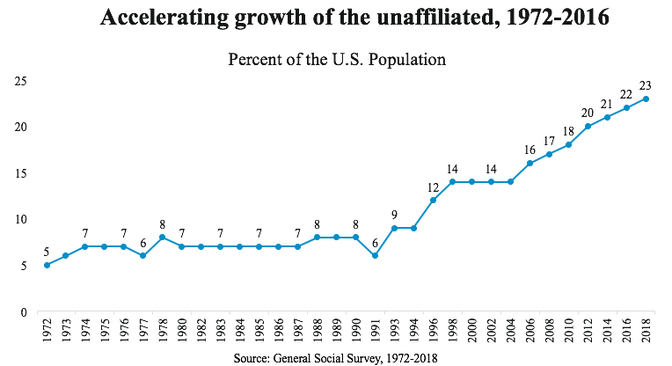
“Survey evidence from countries containing over 90% of the world’s population indicates that in highly secure and secular countries, people are giving increasingly high priority to self-expression and free choice, with a growing emphasis on human rights, tolerance of outsiders, environmental protection, gender equality, and freedom of speech.” [2]
I believe that in the past, religion was the only way to maintain a hierarchical structure in agrarian societies; we see this in the feudal system, for example, and monarchies where a metaphysical entity such as “god” chose the monarch.
“As societies develop from agrarian to industrial to knowledge-based, growing existential security tends to reduce the importance of religion in people’s lives, and people become less obedient to traditional religious leaders and institutions.” [2]
This fading of religion illustrates how actively engaging in anti-religious action is not valuable; I would even claim that it has the contrary effect. When people’s religious beliefs are scrutinized, censured, and aggressively challenged, they tend to dig their heels into the ground and challenge said contentions. This occurs because said individuals possess the notion that they are “being attacked” and therefore must defend themselves. Aggressively challenging religious individuals could even have a radicalizing effect and further drive them into zealotry. This effect can be observed, for example, when we look at the Spanish civil war. The republicans (the leftists) fought against Franco and the nationalists. This fight against the right also came with a fight against the church.
“In the early months of the conflict, individual clergymen were executed while entire religious communities were persecuted, leading to a death toll of 13 bishops, 4,172 diocesan priests and seminarians, 2,364 monks and friars, and 283 nuns, for a total of 6,832 clerical victims, as part of what is referred to as Spain’s Red Terror.” [3]
This event led countless religious people and even non-religious people to condemn the left for these attacks and the church’s persecution, which just gave franco more power to attack the left. Sure, nowadays, the western left might not be executing clergy members and burning churches, but there is still persecution.
The idea of labelling religious thought as “counter-culture” will not prompt a decrease in the religious population; in contrast, we can discern that anything designated as “counter-culture” has a massive propensity to grow more popular. Let us look at the Vietnam war, and the protests that ensued to demonstrate this better. A significant portion of the people opposed to the Vietnam war were so-called “hippies”. Hippies were a majority of young, white, and middle-class people who felt alienated from society and rejected the idea of conformity to virtually any standards of society. Men would grow out their hair to not conform to gender norms, and women would cut their hair short for the same reasons. They would explore things such as spirituality to go against the Judeo-Christian tradition. Hippies would essentially take on any traits or behaviours that did not fit within society as they knew it; they were self-proclaimed contrarians. There are two types of contrarians, contrarians who are by nature contrary, and people who have a notable, subtle perception, are honest, and have the intelligence and drive to organize their perceptions into a new gestalt. A vast majority of Hippies would be classified as the former, contrarians for the sake of being contrarian. This notion of being contrarian for the sake of being contrarian has existed for millennia, and I doubt it will disappear anytime soon. The war on religion could be a dangerous cultural conflict and one we might lose. The war on religion might not be a war worth fighting.
For transformation, we need power, and in democracy, power is people; pushing individuals from the left is opposed to the primary goal of any political idea or movement, which is to grow. The anti-religious view the left expresses is nonsensical, especially since it prevents the world from seeing proper material change.